Welcome to the Cali Death blog! This blog is associated with the Cali Death Podcast, hosted by Anthony Trapani, Joel Horner, KC Howard, and myself, Josef Kay.
As a musician-writer, I’ve wanted to embark on a writing project that builds upon the content that we create with the Cali Death podcast. Ultimately, I’m interested in a book project that documents the history of the California Death Metal scene. This blog serves as a space to share some writing as I work towards the book project.
Let me begin by introducing myself and describing some of the background behind Cali Death. I am an academic by training, and I currently work as a university lecturer. I am also a musician that plays drums in several bands. Right now I am behind the kit playing for Transcend the Realm (OC Progressive Tech Death), To Violently Vomit (Disgorge continuation project with Diego Sanchez), and Dreamer (LA Extreme Prog Metal). Finally, I am a music teacher, giving guitar and drum lessons to local students.
The Cali Death Podcast is originally a collaboration between myself and my friend KC Howard. Back in the day, KC used to be my drum & guitar teacher; later on, I taught as part of his music school, Visions Music Academy. With the Cali Death Podcast, we wanted to start an ongoing discussion within the California Death Metal music scene that would allow us to talk to some of our musical peers and icons and document the scene’s stories and history. As we launched the podcast, we were joined by KC’s musical collaborators Anthony Trapani and Joel Horner, who became co-hosts and drew upon their extensive social networks to help bring guests to the show. KC handles most of the logistical and technical aspects of podcasting, while I’ve been creating the show flyers and sourcing fan questions.
When we started, we quickly identified four bands that represented the classic “California Death Metal” sound: Deeds of Flesh, Disgorge, Severed Savior, and Decrepit Birth. We were able to bring core members of each of these bands on to talk about their musical careers for our first four episodes, which laid the groundwork for the podcast’s focus and scope.
From the comments and feedback we received from listeners, it became clear that we had hit on something important. The “classic” 2000’s era of California Death Metal has a large fan base who were stoked to hear from these guys, most of whom hadn’t given interviews in many years. Our listeners shared stories of going to concerts, meeting bands and hanging out, and we got to interact with people around the world who had some connection to this scene.
As the podcast continued, with subsequent episodes featuring more musical guests from the CA death metal scene, it struck me over and over again that the musical history we were documenting through verbal account could be chronicled in a variety of additional forms. And as an avid reader and writer, I had the nagging feeling that someone should write a book about all this – a book that tells the history of California Death Metal.
From our very first episode, it struck me that a central figure of this story is Erik Lindmark, co-founder of Deeds of Flesh and Unique Leader Records, who sadly passed away in 2018. I never met Erik, but his influence on the scene was legendary, as he inspired scores of musicians to follow in the footsteps of Deeds and create the most twisted and brutal forms of music possible, while also providing them a platform to record and perform.
From the early albums of the late 1990s, moving into the classic era of the mid-2000s, it is apparent that musicians like Erik Lindmark, Jacoby Kingston, Mike Hamilton, Matt Sotelo, Bill Robinson, Diego Sanchez, Ben Marlin (RIP), Mike Gilbert and Troy Fullerton made major innovations that evolved death metal from the early “old school” sound of Florida and New York into a matured style that featured novel riffing styles, song structures, lyrical themes, and rhythmic forms. At its heart, the Cali Death Project attempts to understand how a scattered group of musicians managed to come together and create a distinctive musical art, weaving together the personal narratives and creative connections that right now exist in scattered form.
So, that’s the idea behind the book project. There are a few books out there about death metal’s history, including Albert Mudrian’s Choosing Death and Daniel Ekeroth’s Swedish Death Metal; I intend the Cali Death book to be similar in kind, though as far as I know, no existing book details CDM in any detail.
This blog exists not just to support the book project, but also as a space for writing related to the Cali Death Podcast and the other projects that we hosts are working on. Stay tuned!
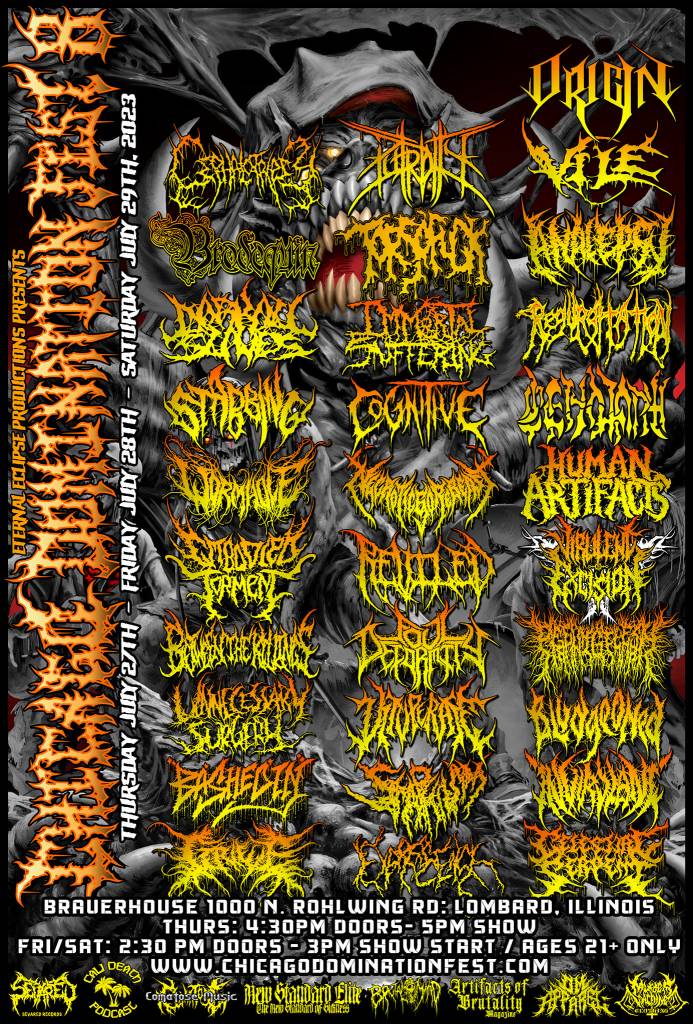
The most recent headliner announcement is Origin. There are two more headliners to be announced, making this one of the most exciting festivals in recent years!
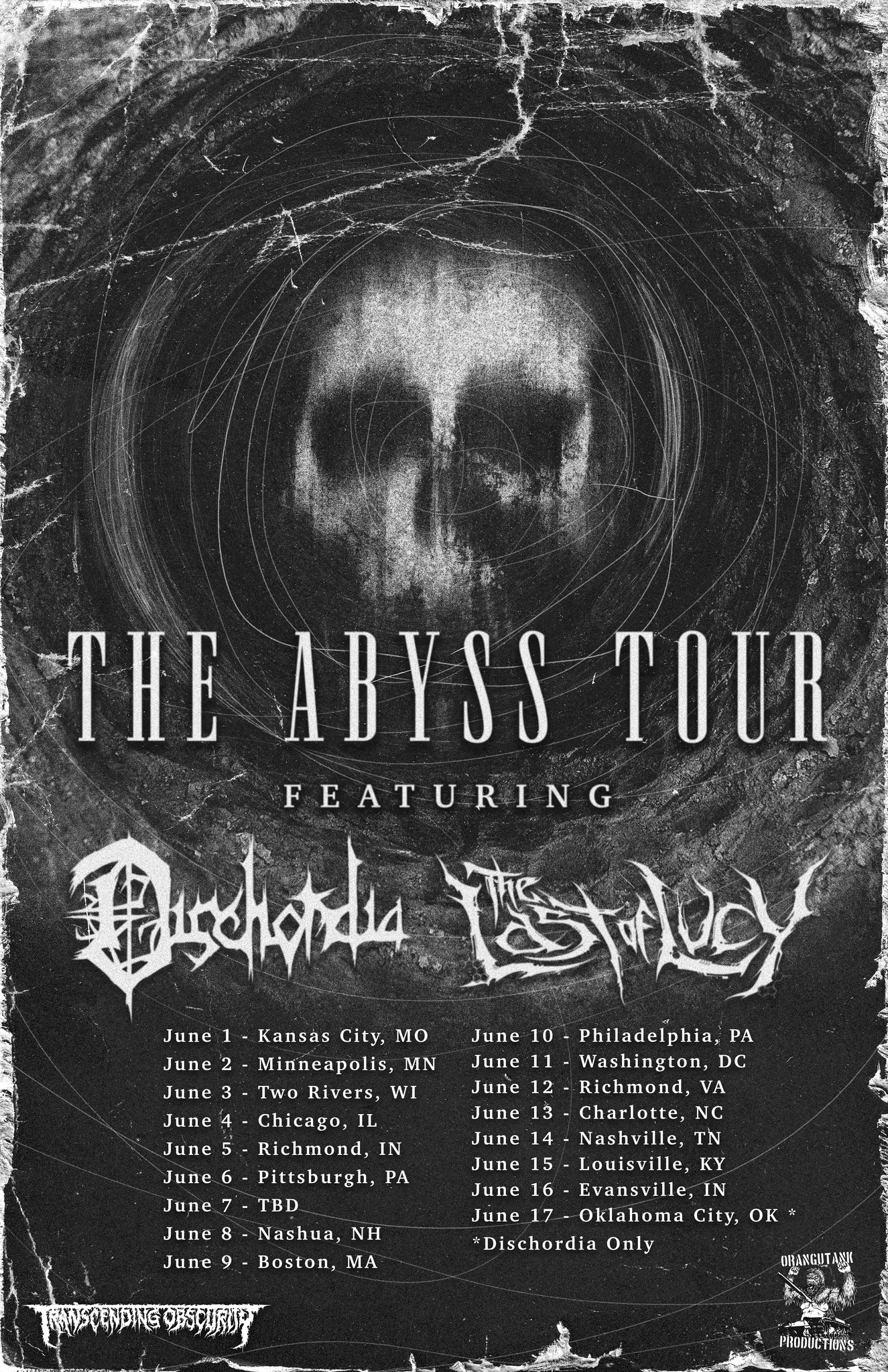
Transcending Obscurity labelmates Dischordia and The Last of Lucy will be bringing their distinct brands of technical death metal across the eastern United States this June on “The Abyss Tour.”
Dischordia’s latest offering is 2022’s Triptych. Mixed and mastered by Colin Marston (Gorguts, Replicant), the album showcases the band’s signature dissonant brand of tech death with similarities to bands such as Ulcerate, Sunless, and Ingurgitating Oblivion.
The Last of Lucy will be premiering material from the band’s forthcoming album, which features production and mixing/mastering by Dave Otero. The new record takes the bangers-only formula of 2022’s Moksha and updates it to be heavier, faster, and catchier, while also incorporating elements of the band’s previous progressive/mathcore style.
In addition, the Chicago and Richmond, ID shows happen to line up with First Fragment‘s routing dates on the way home from their U.S. tour, making for an exciting two-night tech-death trifecta.
Dates and venues for the trek are below:
6/1 Kansas City – Westport Bowery
6/2 Minneapolis, MN – Mortimer’s
6/3 Two Rivers, WI – Whisky D’s
6/4 Chicago, Il – Reggie’s (with First Fragment)
6/5 Richmond, ID – E Street Pub (with First Fragment, Carrion Vael)
6/6 Pittsburgh, PA – Shred Shed
6/8 Nashua, NH – Nashua Garden
6/9 Worcester, MA – Ralph’s Diner
6/10 Philadelphia, PA – Ortlieb’s
6/11 Washington D.C. – Pie Shop
6/12 Richmond, VA – The Bike Shop
6/13 Charlotte, NC – The Milestone Club
6/14 Nashville, TN – Venue TBA
6/15 Evansville, IN – Lamasco Bar
6/16 St. Louis, MO – Platypus
6/17 Oklahoma City, OK – Rayfest (Dischordia Only)
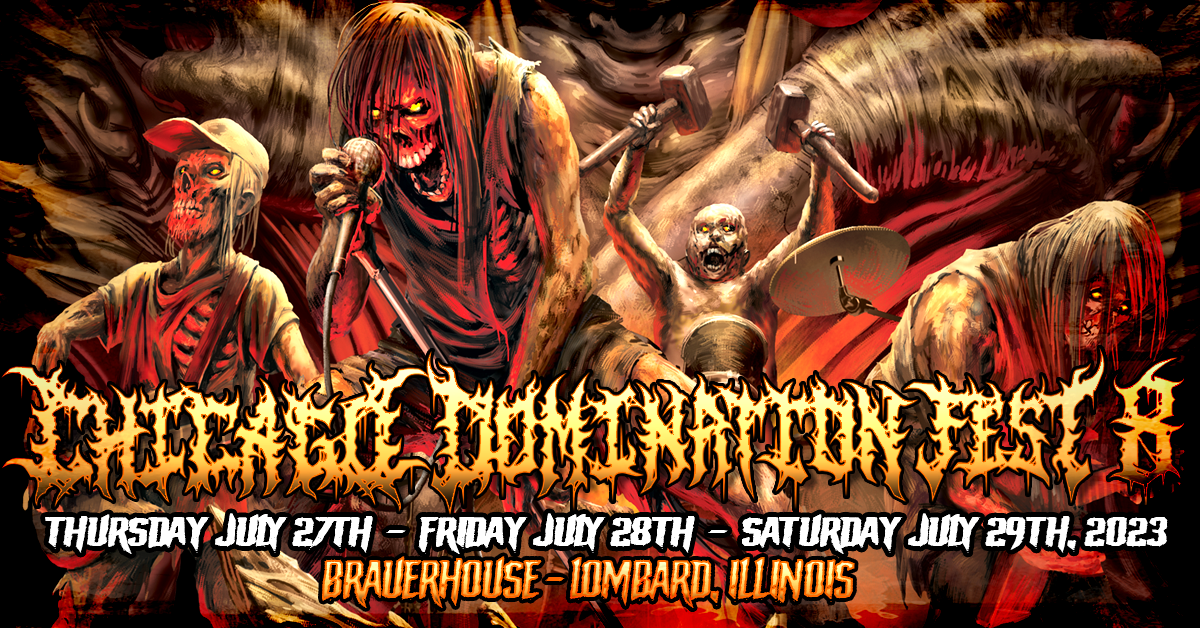
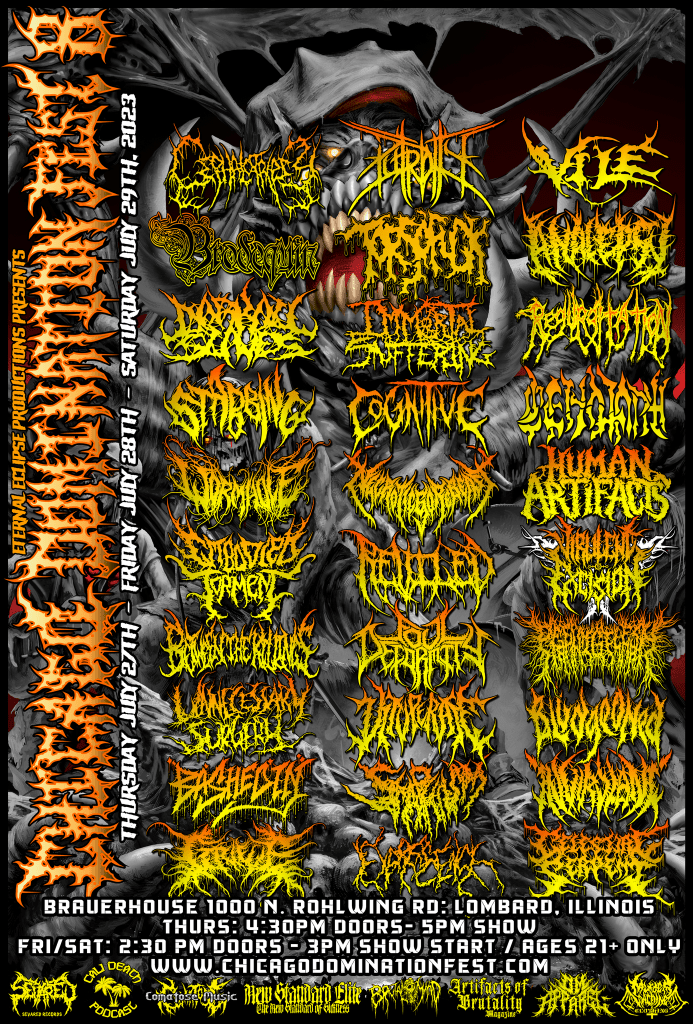
Cali Death Podcast is proud to be an official sponsor of Chicago Domination Fest 8, which takes place July 27-29that Brauerhouse in Lombard, Il.
UPDATE: Since the original post, 3 more bands have been announced: Cephalotripsy, Putridity, and Vile. The festival flyer has been updated to reflect this announcement.
Chicago Domination Fest is coming back bigger than ever in 2023 thanks to the hard work of organizer Miguel Goregrinder and his team. Thus far, twenty seven bands have been announced, and it’s already shaped up to be a great festival, with old school acts such as Immortal Suffering, Human Artifacts, and Brodequin appearing alongside popular acts from recent festival iterations such as Stabbing, Reviled, and Wormhole.
But with six bands awaiting announcement, it’s quite possible that CDF 8 is the most ambitious underground death metal festival in years. In fact, we at Cali Death Podcast can be quite confident in saying that CDF 8 is destined to be a legendary, S-tier festival, as we’ll be announcing three more bands on our episode #124 coming this Thursday, April 6th.
Tickets for Chicago Domination Fest are on sale here. You can also follow CDF on Facebook, Twitter, and YouTube.
Below are some Cali Death Podcast episodes featuring guests who have performed at CDFs of the past:
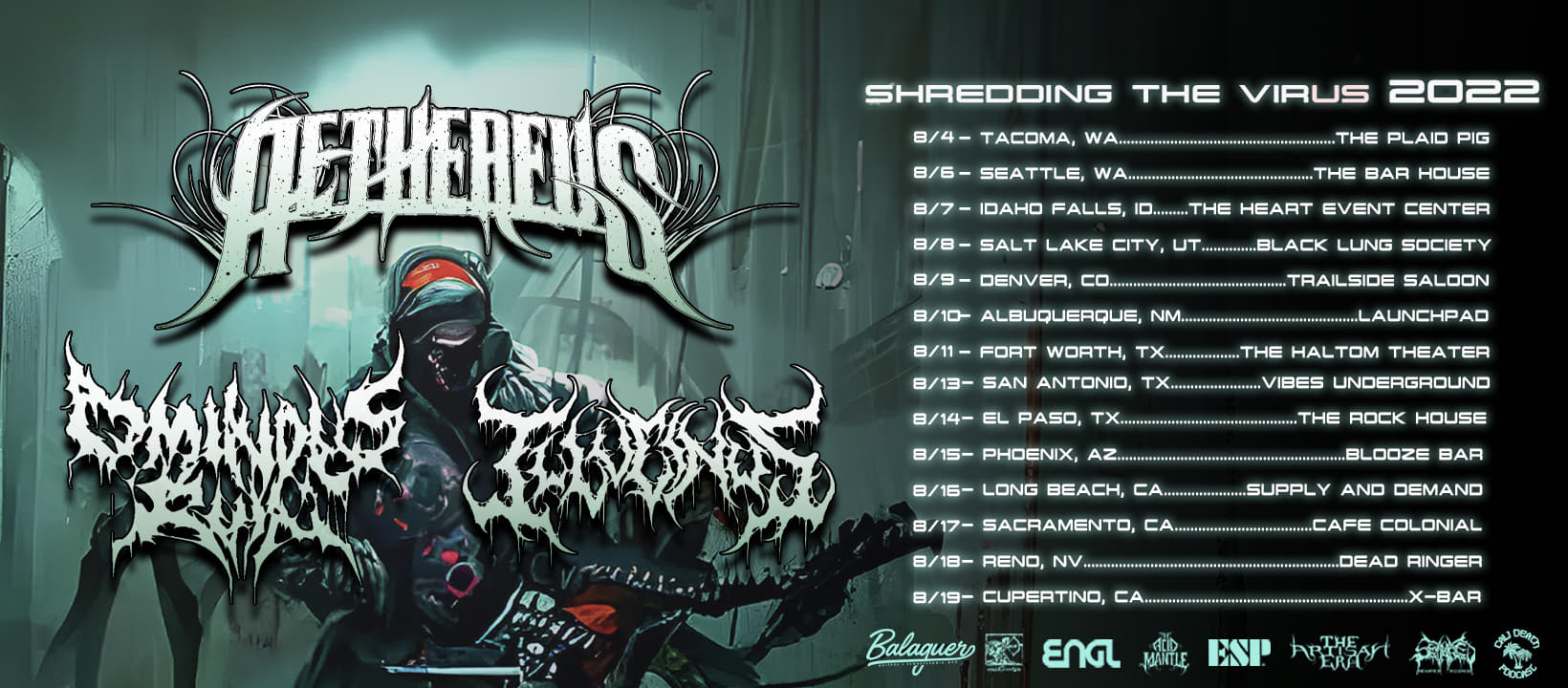
Cali Death Podcast is proud to sponsor the Shredding the Virus 2022 Tour, featuring Aethereus, Ominous Ruin, and Illucinus. The tour kicks off on August 4th in Tacoma, WA, and finishes up August 19th in Cupertino, CA. Full dates listed below.
To promote the tour, Cali Death Podcast will host a special episode on Tuesday, July 19th, at 8pm on Twitch, featuring Kyle Chapman (Aethereus), Alex Bacey (Ominous Ruin), and Petr Oplatka (Illucinus).
Blogging returns to calideath.com! Coming off our recent episode #37 with Dennis Röndum, drummer and vocalist of the legendary Spawn of Possession, we had a great career-spanning discussion, with several interesting topics that are highlighted below.
Recording the drums for “Scorched”
“Of all the secrets I know only one… My shadow’s buried, my soul is not”
Spawn of Possession pushed the boundaries of death metal in nearly every direction: songwriting, groove, technicality, and yes, speed. The song “Church of Deviance” off of 2003’s Cabinet showcases Dennis throwing down some super fast hammer blasts. But their 2006 album Noctambulant, altogether perhaps a more varied release in terms of tempo and drum patterns, features the now-infamous “Scorched” as album closer. Clocking in at 310 bpm, Dennis plays long passages of simultaneous 8th notes with both hands that propel the song forward at blistering speed, while the guitar riffs and vocals weave together the conclusion of the album’s narrative concept. Given the ridiculous bpm of the song, I had to ask Dennis about its recording, which led into a nice discussion about his approach towards recording and plans for “Scorched” to be performed live (which were sadly never realized).
Starts at 1:06:10
Josef: Did you actually play “Scorched” in the studio at the recorded tempo, which is something like 310 bpm?
Dennis: Yeah, but it’s with punch ins. I didn’t play it in one take, for the record. It’s not a one take song, having a snare that like, hitting that hard, in that tempo. It’s doable – I could have done it, maybe. If I had all the time and all the money, maybe I could have done it.
But again, the whole thing with the studio for me, the prestige about that: look, I totally respect musicians going in just nailing it – man, I take my hat off to that. But for me, I have a slightly different philosophy, because – if you’re comfortable doing that, go ahead and do it. But for me it’s like, here we have all this technology, and I hope people are not listening to it and thinking like, “Is this a first take?” Because I don’t think like that when I listen to music. Maybe I did way back, but now I don’t pay attention to that stuff because I don’t think it’s relevant; what’s relevant is how it sounds. Then we can talk about how you did it, but then again, you have to go on stage and perform, so that’s where the sort of evidence comes out if you’re into that…
I mean, when we practiced it – like me and Jonas practiced it – we played the song, like we played it [all the way through]. But I didn’t have a click track in the practice pad, so obviously, was it like that tight, like record tight? Probably not, you know, the chances are, you know, no.
But the whole idea was that, we’re going to do it live. Because we always finish the shows with “Church of Deviance,” like a quick sort of in-your-face beat. [Jonas] said, “We’re going to play Church midway and end the show with Scorched, that’s going to be awesome.” And also: the only prestige I have ever had as a drummer is playing the hardest fastest song last, when you’re the most tired. It’s like a little, “Oh you’re so tired? No watch this;” and then you play [fast]; it’s like a fun thing. Well, what happened there was that even before the album was released and we hadn’t had any time to to practice, after the studio we got an offer to do a tour with Hate Eternal. Then the other guys in the band didn’t know Scorched, along with half the [new] album. They couldn’t play those songs, they hadn’t learned it. So we had to scramble a set really quick, so we had like “Lash By Lash,” “Sour Flow,” and one more song – those were the ones that they knew how to play, so that was what we brought on the road…
Speaking about Noctambulant and the song “Scorched,” I actually cheated a little bit, because when we started that song, I recorded midway and I stirred it up and gave it a couple of shots to get it going. Because it’s very fast, it’s just like – I’m not gonna be silly about it, it’s a fast song. And then behind me was a window, and in the window was a bunch of drumsticks and stuff that other drummers had left. It was just like a whole collection, and I found like a drumstick – it was like extremely small and it weighed absolutely nothing. I was like, “What is this? This is a toy. ” I don’t know what this is. But I actually used that – it kind of made it a little easier. I had to hit harder to get the strength [velocity], but it was slightly easier to play. So that’s how I sort of got through it.
I just remember that now, I had this little toy stick or something. But yeah, I used my fingers pretty much when I play anyway, but it was just a little easier to maneuver with it. I felt afterwards, I was like, “Man I got to get those.” But then I felt, you know, for the more heavier parts, like when you slow down and you want to do the toms, it wouldn’t really work; you need real sticks.
I just gotta say, like a dream scenario, was that me and Jonas wanted to play it on the tour we did with Hate Eternal. And like a dream now would have been like if we performed it live, and I played it the way it should be played, and somebody videotaped it [and put it] on Youtube. So like, there you go. But it happened with Church of Deviance, so it’s out there, but yeah…
Begotten
Another highlight was hearing Dennis talk about a project he joined after leaving Spawn of Possession in the wake of Noctambulant and an ill-fated European tour (he rejoined the band as vocalist for 2012’s Incurso). Begotten featured Dennis (as guitarist) alongside other ex- and future- SoP members. The project was mentioned a couple of times in interviews back in the day; however, even though they recorded an entire album and landed a contract, nothing from the project was ever released. Needless to say, I was quite interested in hearing more about this band.
Dennis: After Spawn I went away on my own, and I did a record with Nick, where I play guitars and I do vocals, and Nick plays bass. And then Henrik, we found through Rob [SOP producer] and Flat Pig Studios. He had been in a bunch of bands, and he played the drums. And then we found “Germ,” Martin [Bermheden], who had played on the last Visceral Bleeding album. So he came in to do the solos and stuff.
We record this whole album, and pretty much mix it and everything, and then it just… I don’t know what happened. It’s not been released. The album cover is there, the deal is signed, and you just… I don’t know. So we’re struggling, like: “we should put this out.” That album is more than 10 years old and it’s ready. And it’s like a totally brutal thing. It’s not Spawn or anything but it’s it’s very brutal.
Josef: What’s the name of the project?
Dennis: Begotten.
Josef: You’re saying there’s like a hidden, almost-Spawn of Possession album that just never came out? That’s insane. I know it’s not actually Spawn of Possession but…
Dennis: Yeah, whatever I do, people are gonna compare to Spawn. Which is okay, I get that, but it’s unfair because Jonas is the real mind behind Spawn; he is the genius in Spawn of Possession. But Jonas has heard the album, and to my surprise, he was really giving me a lot of props for it. He was like, “Man it’s awesome, release it, what the fuck, it’s great,” you know. It’s very brutal, it’s just like a lot of blast beats and it’s a very live recorded, one-take kind of thing, to get a certain old-school imperial doom kind of vibe. Hard-hitting; it’s a brutal album, and I loved recording it and Rob’s going to [finish mixing] it; it’s just a matter of time to sit down and do it but hopefully…
We actually signed a record deal with Willowtip, but it was signed like 10 years ago. I don’t even know if the deal is still on. I don’t know. We gotta email them…
[In response to an inquiry from me in the YouTube comments of the episode, Rob from Flat Pig Studios says: “I cannot say too much about this… but something might just be in motion…” ]
Apologies for the hiatus in blog posts. I haven’t had the time to update the website since I got a new teaching position, and I started renting a new lockout for band rehearsals. More Cali Death content will appear here eventually.
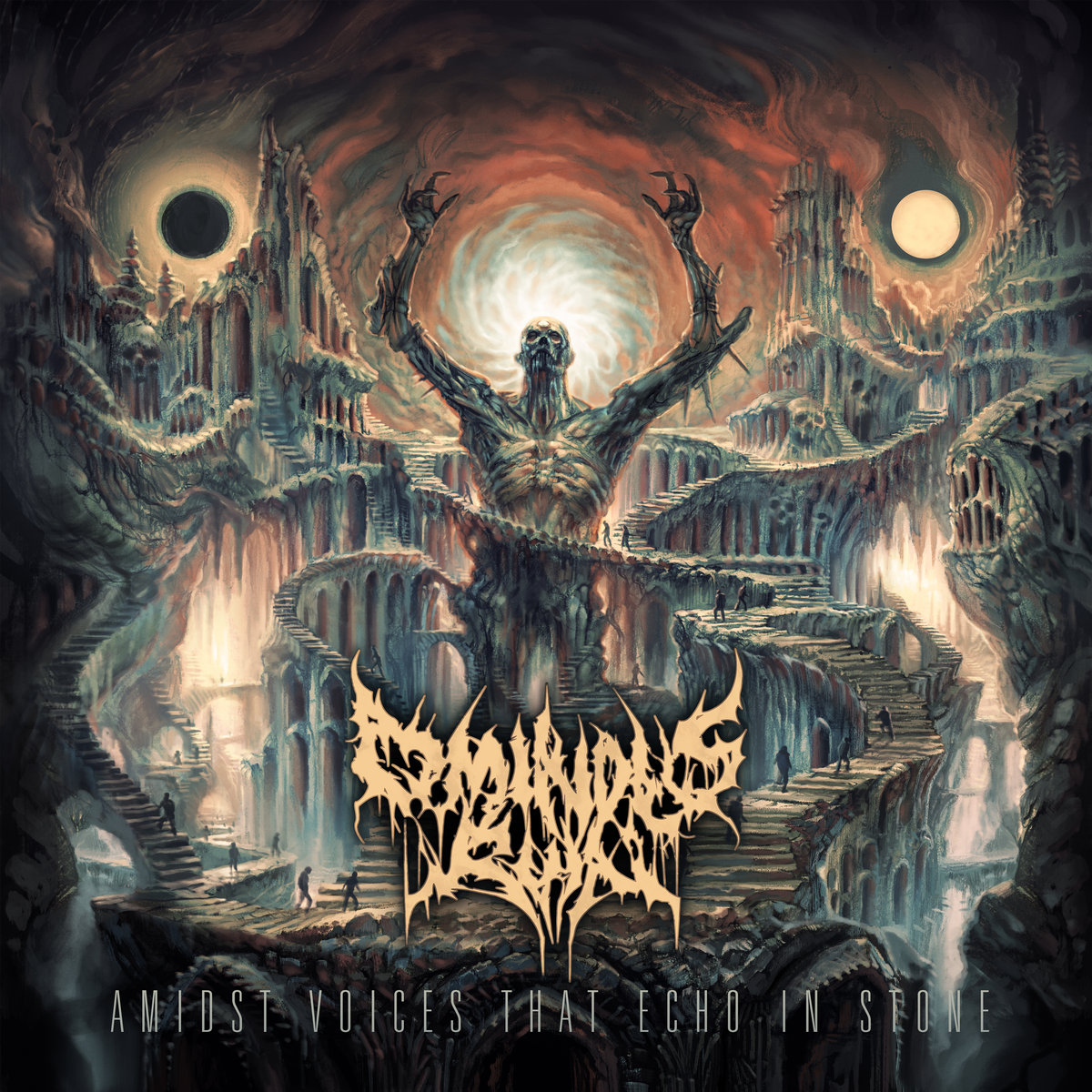
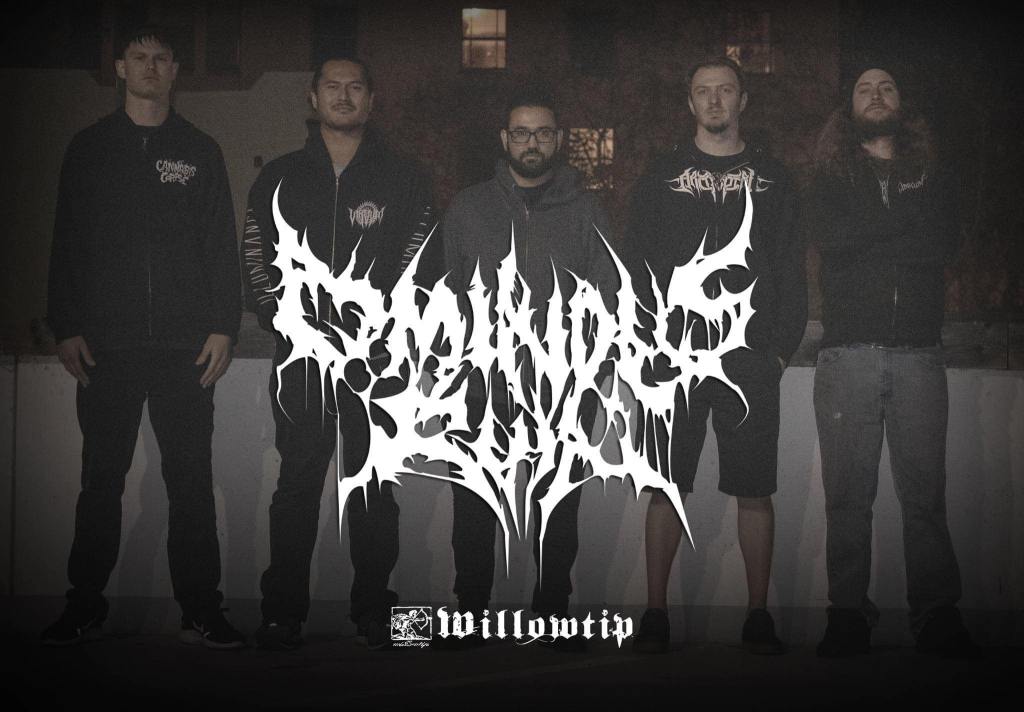
It’s rare for a technical death metal band to have as much hype as Ominous Ruin are currently enjoying. I would attribute the hype both to the hunger within the metal community for quality tech death, and to the band themselves for delivering music that satisfies this demand. With Amidst Voices that Echo in Stone, out February 26th on Willowtip Records, Ominous Ruin demonstrate a mastery of the genre, utilizing razor-sharp riffage and calculated brutality to craft a collection of memorable songs that are full of suspense and vitality. Their offering has already reinvigorated a scene that one might have thought had already passed through its heyday.
L-R: Joel Guernsey, Harley Blandford, Adam Rosado, Alex Bacey, Mitch Yoesle
The best way to appreciate Amidst Voices that Echo in Stone is to compare it to earlier Ominous Ruin releases. Their 2011 and 2014 demos (later compiled onto a promo) and their 2015 EP, Exiled, exhibit the same tech death style as the new record, but are musically simpler, somewhat lacking in production value, and ultimately didn’t help Ominous Ruin stand out from the pack of similar bands. There’s still hints of the band’s later sound that are present in this early material, including creative use of catchy rhythms and chord-driven passages, but the songwriting chops and technical prowess simply aren’t yet there.
On Voices, however, not only is the quality of production greatly improved, but the songwriting has reached a tipping point. Each song evolves a set of musical motifs through cascades of twists and turns in service of the overarching composition, and the elements of riff, pattern, lyric, and melody all work together to support the dramatic storytelling that emerges. This is apparent in the first two tracks from the album, “Ritual” and “Attuned to the Chasm,” which have both been released as singles:
The foundation of all death metal is sick guitar riffs, and guitarist Alex Bacey is incredibly consistent at delivering well-crafted riffs that exploit interesting harmonic and rhythmic ideas. There’s a balance between riffs that are catchy enough to serve as hooks that get stuck in your head, and evil-sounding riffs that elicit the stank face. There’s also a good amount of solo sections that contribute to the virtuosity on display without meandering into instrumental worship. The guitars are presented on a relatively low-gain setting, and it’s refreshing to hear the natural character of the instrument breathe within the space of the mix, especially during some of the chugging parts that might otherwise be oversaturated.
The songs are propelled forward by the phenomenal talent of vocalist Adam Rosado, who boasts a wide palette of vocal styles (occasionally supplemented with tastefully chosen FX). Many of the vocal patterns showcase Rosado moving from his rock-solid mid-range into an earth-rumbling gutteral or piercing high. The vocals are a little quiet in the overall mix, but that doesn’t prevent the listener from appreciating Rosado’s breakout performance.
I’ll echo previous reviewers in applauding the bass performance of Mitch Yoesle, who serves up some of the most tasteful lead sections ever put forth on a tech death record. The production serves Yoesle well, as the bass is ever-present in the mix, and yet Yoesle avoids over-playing in the way that hampers a band like Beyond Creation. But perhaps the best production is reserved for session drummer Andrew Baird, who delivers the best-captured performance of his career. Baird’s tasteful drumming brings life to these songs and underscores the value of human performance in a genre that, due to a variety of constraints, often resorts to over-sampled or fully-sampled drum tones.
It’s helpful to compare Ominous Ruin to Inanimate Existence and Fallujah, as these bands overlap with respect to membership (Fallujah is Baird’s main outfit, while Yoesle and incoming guitarist Joel Guernsey both had stints in Inanimate Existence). Both of these bands have taken technical death metal into novel territory, exploring new progressive atmospheres and moving away from some of the tropes of the traditional tech death formula. Because of this progression, the tech death mantle has arguably been left vacant for a band like Ominous Ruin to claim, by showing how the style can be augmented by influences from a variety of different genres without shedding the fundamental commitment to catchy riffing and crystal-clear production.
This is apparent on album highlight “Deception”, which (SPOILERS AHEAD) showcases the band unexpectedly yet effortlessly sliding into a blackened metal aesthetic, while maintaining their adept sensibility throughout the passage. The guest vocals in this section add additional novelty to its sonic character, and the whole passage feels musically natural and expansive. Throughout Amidst, there are several such passages that expand on the traditional tech death formula and show that the band is still in dialogue with current metal trends. Clean guitar drones, hooky headbang sections, and doomy atmospheres keep the album sounding fresh and help prevent listener burnout.
Overall, Amidst Voices that Echo in Stone reminds me why I love death metal in the first place, technical death metal in particular: it triangulates between brutality, virtuosity, and progressive elements to deliver a tight package of sick songs. I’m already seeing “Album of the Year” getting thrown around in discussions online, and I’m sure that Ominous Ruin will be at or near the top of my 2021 list. The next challenge for these guys will be seeing if they can pull it off live, but based on the instrumental playthroughs that I’ve seen (soon to be released to the public), I’m certainly expecting them to execute this material in the concert setting. It’s my hope that this album forms part of a new renaissance of California technical death metal, and that the band continues to produce killer music for years to come.
If you want to take a deep dive into the band’s background and influences, check out Ominous Ruin’s appearance on Cali Death Podcast:
Defeated Sanity’s Chapters of Repugnance (2010), once advertised via CD sticker as “the most brutal album of all time,” owes its heaviness in part to the insane vocals of California Death Metal vocalist AJ Magana. In this excerpt we asked the band how they got hooked up with AJ to record the album and perform a select few shows.
Starts at 57:58
Josef: Someone asked, “How did you guys convince AJ to do the Chapters of Repugnance album?”
Lille: So the story is, between Christian, my dad and I, we watched Disgorge in Ohio with AJ at one point. And whoever knows that video knows what AJ brings to the table. I just remember the phrase back then was, “The best death metal frontman of all time.” So between the three of us, I don’t know, it was just a thing, and we were like, “that guy is just – that’s just crazy.” it’s just like, “That’s kind of what we need.” And then, funny enough Josh says he religiously watched that video as well.
Josh: Oh yeah, it’s a classic video.
Lille: So the link was, of course, as so many [other] times, Derek Boyer. I got a hold of him via email, like: “Hey, do you know what AJ is doing at the moment because we’re looking for a vocalist.” And Derek actually says – Derek and AJ, they seem to me like they’re like a clique of two or something. They have this mindset – two peas in a pod – they have this mindset about music; musical perfection is just really important to them. I just felt like I’m the same, just on a different part of the planet. Derek just said, “Hey, he would love your drumming, I’ll put you too in contact.” And then I sent him the promo 2007.
I remember he was like, “Yeah this stuff’s good but I’ll make it better.” I was like, “Yeah, I believe that.” But I guess basically he was into it – I think he liked just like the intricacy… That Deprecated EP, I saw like they were greeting their influences, and it was like Cynic, Immolation, Suffocation, Gorguts. It looks like we have the same roots, so I guess [that’s why we] just got along right away. And me also being a huge Deprecated fan too. I guess it was kind of reciprocal.
Then he came over [to Germany] and we had like a week to get down the vocal patterns. Most of the lyrics I had already written; he added a few words here and there. Most of the vocal patterns were already done, And that was just basically AJ and I in a room, working on that stuff. It was pretty amazing, he came out of the airport, I picked him up, and I’m like, “Okay, this guy wants to rest now, probably.” And he was like, “So where can I get a red bull? Let’s start working right now.” And we’re like, “Yes!” That’s my kind of guy.
So I remember, back then when we had the room right above the rehearsal room, we had the demos on cassette tape, from the Tascam. And we’re going over them, and he was basically shaping, perfecting his vocal lines. I remember, of course, we had a few places to fill for vocal lines, so he filled them in. He basically came over a week before we went into the studio. So he didn’t just come over to practice but it was like, “Okay, we have one week’s time.” And then we got studio time booked, so we really made that happen and then came out of the studio and went straight on stage and played everything live. Yeah that was crazy…
Josef: The album you made with him, Chapters, I remember seeing it in stores and it had the promo sticker on it, like: “the most brutal album of all time” which is true! And the style is a little different than Psalms, just the way that album starts and like just throws you into like the jazz and then the blasts like almost right away. But Chapters has that really long build up and it’s much more of a dramatic kind of statement with like a long intro. I just listened to you and Jacob talk about jamming drums and bass while writing the album. How did you guys engineer that album and get that guitar tone?
Jacob: So when AJ arrived we were just done with tracking drums, guitar, and bass. We did it all in an old studio that I used to rent out in Berlin. I was engineering it, and Wolfgang wasn’t around anymore for that. So for the first time it was all Christian. I think he still used that – it was a little tri-metal pedal. On Psalms he had the Zoom multi effect, like a three button push or whatever, then for that one it was just a little solid state – just a little gain, a distortion pedal, that was really hard to find too. And it had some like dings and dongs and wasn’t like sometimes the the knobs would be like scratching – once you had it all set you couldn’t touch it. But it delivered that sound, that just ultra scooped, brutal death metal, like endless sustain kind of sound. And that’s what we recorded with – that through a JCM2000 amp. That’s how we recorded the guitar. And then when AJ came we were just done with that and we just had a few days to to get his vocals tracked.
We did one show with him: we went straight to Mountains of Death Open Air in Switzerland, which is an epic festival. Used to be – not around anymore unfortunately. And that was not just the first show with him, but the first show playing all of Chapters, basically in one go. It was a pretty epic experience for us, just to play with this new dude, all new songs, and just trying to have the faith that we can do it without really having done it before.
In this excerpt from Ep. 4, Diego Sanchez talks to us about his family’s musical heritage, getting exposed to death metal in high school, playing in Strangulation alongside Ben Marlin and Travis Ryan, learning alternate picking in order to play Disgorge, and writing the material for 1999’s She Lay Gutted.
Starts at 4:29
Anthony Trapani (4:29): When did you pick up a guitar?
Diego Sanchez: I was in high school, I was 15 and a half years old.
Anthony T: What made you want to get that guitar?
Diego S: Oh man, I wanted to play guitar since I was a little kid. My brother, Joe Sanchez, is seven years older, and I can remember being like young, like five or six years old, and my brother’s getting my mom’s tupperware, and chopsticks (because we were in Hawaii), or pencils, and just playing on that until he got his own kit years later. So music’s always been in my blood. My grandfather was in the San Diego Symphony, and that’s where all that [technique] came from. But I didn’t know until later; I was just a dude that played guitar. Because he always wanted to play guitar, because his brother played drums, so next thing you know he bought me my first guitar. That’s when I started working summer jobs, and I built up my amp, from like Boss regular distortion pedals and EQ, and then Metal Zone, and then a Randall half stack, then a full stack.
Anthony T: Were you jamming covers and stuff first?
Diego S: Yeah, that’s how I learned – no lessons, no nothing dude – just watching MTV, and my brother is seven years older, so he was already in his teens jamming.
Anthony T: Was that your first experience jamming with another person?
Diego S: Pretty much, yeah.
Josef Kay: Is this the Joe Sanchez that was in Strangulation with you?
Diego S: Yeah, he was the vocalist in Strangulation. But we had a band called Malefic Plague, and I sang and played guitar. It was grind death, kind of like early Napalm Death, early Carcass, but with Morbid Angel, Cannibal Corpse flow. Then I discovered Suffocation, and that’s I found out you could be dark and brutal and still groovy. And Morbid Angel also, like all those molding bands.
I just built up my gear, summer by summer, and I got good enough to play in his band. We ended up kicking out the guitar player, because we wanted to be more brutal, and then I was the main writer.
Anthony T: What style was it before you wanted to be more brutal?
Diego S: Well, like Sepultura, Sacred Reich, DRI, Dark Angel, Slayer of course, Exodus, Violence, Forbidden. Next thing you know, I met this dude named Jeff. we called him Satan Jeff, from high school, because, you know, white dude that dyed his hair, and he was like a Wiccan. He was all into black metal, and he opened my mind. I just got experience from my brother, from other people. This was when Alters of Madness had just come out, and Eaten Back to Life had just come out.
Travis Ryan, he and I used to jam back in high school, and he played drums in Strangulation. He was always showing me the next thing: Benediction, Entombed. He took me to my first death metal show.
Mortal Mastication, off the 1994 Severed Carcass Garden demo. Line-up: Joe Sanchez (vocals), Diego Sanchez (guitar), Ben Marlin (bass), Travis Ryan (drums & backing vocals).
Joel Horner: Where did you meet him?
Diego S: Middle school. I was in seventh grade, he was in eighth. We never talked about music back then, and in high school it was like, “What, you’re playing guitar?” or “Dude I’m playing drums, what bands are you into?”
Travis was jamming with Ben [Marlin] and some other dudes from a different school in Escondido. So Ben would get out of school and come and pick us up, and we’d go and jam. Travis asked me for like a year and a half to join his band, because he wanted to make it more brutal. I told him I was playing grind, and what bands I compared myself to. They were still playing thrashy like Slayer, Death, you know, Death is dope but it’s a little different than brutal stuff. Finally I got the confidence, I already had like four or five songs in the arsenal to go and present to these guys. Everybody’s all stern and like, “Who’s this skater guy?” I was sponsored by a couple of shops back in the day, so I was just a skate rat showing up to these hesher metal head dudes. I go in there and I start jamming, and the other dudes are kind of like “What is this?”
Anthony T: How old are you at this time?
Diego S: Dude I was like a sophomore in high school, I was like 15, 16 years old.
Anthony T: So how long was Strangulation going? Did you go straight into Disgorge from Strangulation?
Diego S: Yeah, technically. Disgorge had their first break back in 1996. I had joined the band a couple months before that, and Derek [Boyer] was the one showing me the material. And then the band split up for personal reasons. I had already learned like nine songs or something at that time, just after the third demo had gotten recorded. And then Ricky came back to San Diego, I saw him at some different kind of show, like Incubus, Deftones in their early early era. And he’s like, “Dude I’m back, I’m not playing nothing,” and I was like, “Well let’s do Strangulation,” because I was still bros with Ben and my brother, and I didn’t hang out with Matti [Way] because they lived like 40 miles away, down by the beach; I’m more inland by the mountains. But I was down south at this show, and next thing you know, Ricky came [up] and he jammed. He starts learning Strangulation songs, but Ricky, he played guitar for years before he played the drums, so when he’s playing the drums he’s actually a guitar player playing the drums. That’s why him and I click because I’m the opposite – I’m a drummer, like a percussionist in my head. I don’t play the guitar when I’m playing the guitar, I’m actually playing the drums when I’m playing guitar, if that makes sense.
Matti was in San Diego still, and my brother was getting married, he was the vocals for Strangulation. So he got married and he was gonna have a kid, so we were like, “You know what?” Ricky said there was a big buzz that was going around from Deeds spreading the word about Disgorge from the when the grey demo came out. Next thing you know, the name was already so big. I had just joined Disgorge before they had broken up, so now it’s my opportunity to come back. And Tony [Freithoffer, Disgorge guitarist 1992-1997] and Eric [Flesey, Disgorge bassist 1995-1997] were done, so I could bring on Ben, because you know, Ben was dope. We wrote together for years, and he was a big Disgorge fan too. We would play shows, Strangulation and Disgorge, among a lot of other bands in the local scene. We were all already bros and friends, and we admired each other’s music and stage presences and stuff, and we watched each other evolve.
Disgorge, no matter what, has always had its sound; [If you join Disgorge], you need to come out just as powerful and relentless and dark. You know, there’s like a dark groove.
Cranial Impalement (1999) is a compilation of the 1995 and 1996 Disgorge demos.
Anthony T: So you and Ben got together and and picked up from the first demo and decided, you guys would start writing the material from that point forward, and just kind of took the the feel of that demo and and worked it into your own sound?
Diego S: Yeah, this is after the 1996 demo. There’s the 1995 demo, which is a demo, and then 96, actually that got released [as “Cranial Impalement”] through Extremities first, and then Unique Leader. That’s just a self-titled demo, there were never any titles besides Cognitive [Lust of Mutilation], I think, was the first one [from 1992].
So like I said, Derek showed me the tunes, I got together a band, I showed him the tunes because we lived in the same town and we still kicked it and next thing you know, Ricky was like, “Matti’s still in town, your brother’s on his way out with the family and a secure job, how is he going to tour?” And boom, we just clicked, because Ricky and I had already clicked. It was kind of satisfying, because I was always kind of chasing certain parts back then, and then when we came back and we reformed I had already had the feeling and the flow. And Disgorge helped me evolve as a guitar player, because I had already done down picking. Like if you listen to Legion [1992 album by Decide], all that shit’s just down picking. So I did a lot of down picking back then, and then when I joined Disgorge I had to learn alternate picking. Matti loaned me his baby Taylor acoustic guitar, because it’s a lot smaller, more comfortable in the neck. I got a got a metronome, an acoustic guitar, and I learned how to play Disgorge by playing rewind and play on a tape player when I was working graveyard at a gas station.
Josef Kay: What were the first songs that you brought to Disgorge that are your own material? I think you told me before that you wrote “Exhuming the Disemboweled” (from the She Lay Gutted album) and had it ready to go when you joined the band. Did you have any other songs?
Diego S: That was actually the last Strangulation song that I wrote, and that one never had a drummer. I wrote that song just on guitar, and I brought it to Rick. I brought a lot of Strangulation songs, like rhythms. [The song] “She Lay Gutted” was a Strangulation song, we just rearranged the lyrics a little bit. And “Compost Devourment” used to be a Strangulation song lyrically. The music to “Compost,” that was actually the first song that I wrote with Ricky, and we wrote that song in like 20 minutes. Because I got in a car accident, my buddy rolled his truck out in the desert and I hurt these two fingers on my picking hand. Luckily I could still hold the pick. Rick and I were trying to write material, and we were halfway through it, and all of a sudden the [pain from the] accident came back. We’d play a few little increments, that’s why it’s only a two minute song. We just said “You know what, let’s just get something, you and I, fresh.” I suppose as long as I tried to bring Disgorge flavor, I [could] cut and paste the Strangulation songs- there’s a lot of different rhythms in there… (33:30) I already had a whole Strangulation album written. So when we needed material (because I had already learned the demo songs) we basically cut and pasted a lot of Strangulation stuff, and then Ricky and I found our flow; we just clicked after that.
Josef K (25:20): Lille [Gruber] from Defeated Sanity says, “How did you do such an amazing job at picking up where Tony Friethoffer left off and making Disgorge even better?”
Diego S: I think just from being friends in the scene, and seeing each other play live. And like I said earlier, when I was learning how to play guitar for Disgorge with a metronome and an acoustic, I had to change my style. So the rhythms I had in my head, I wasn’t able to play it – I didn’t begin as a guitarist able to play those. And then when I learned Disgorge material, with all the alternate picking and the weird little flows and tweaks and nuances in there, and the brutal consistency, that’s like a metronome in itself. And when Ricky was playing his drums, he’s putting all he has into it.
It comes easy, I think, from my grandfather’s blood – being the classical violinist. So this hand has it. And I’ve got a lot of different cousins that are drummers, along with my brother being a drummer. But, you know it’s just in my blood. I had the stuff in my head before I could play it, and then I learned how to play Disgorge songs, and next thing you know, I myself evolved as a guitar player. Because now I’m doing alternate picking as opposed to down picking… The alternate picking allows you to to access even more that you would never be able to do down picking.
I’ve been focusing on these so far, as there is plenty of great content from our early episodes that can be made more accessible this way. In addition, once transcribed, our guest’s recollections of Cali Death history, can be incorporated into the eventual book I’m planning to write.
I’ve also been updating the early episode YouTube videos to include chapters (timestamps), which should make it easier for listeners to access sections of interest.







 Cali Death Blog